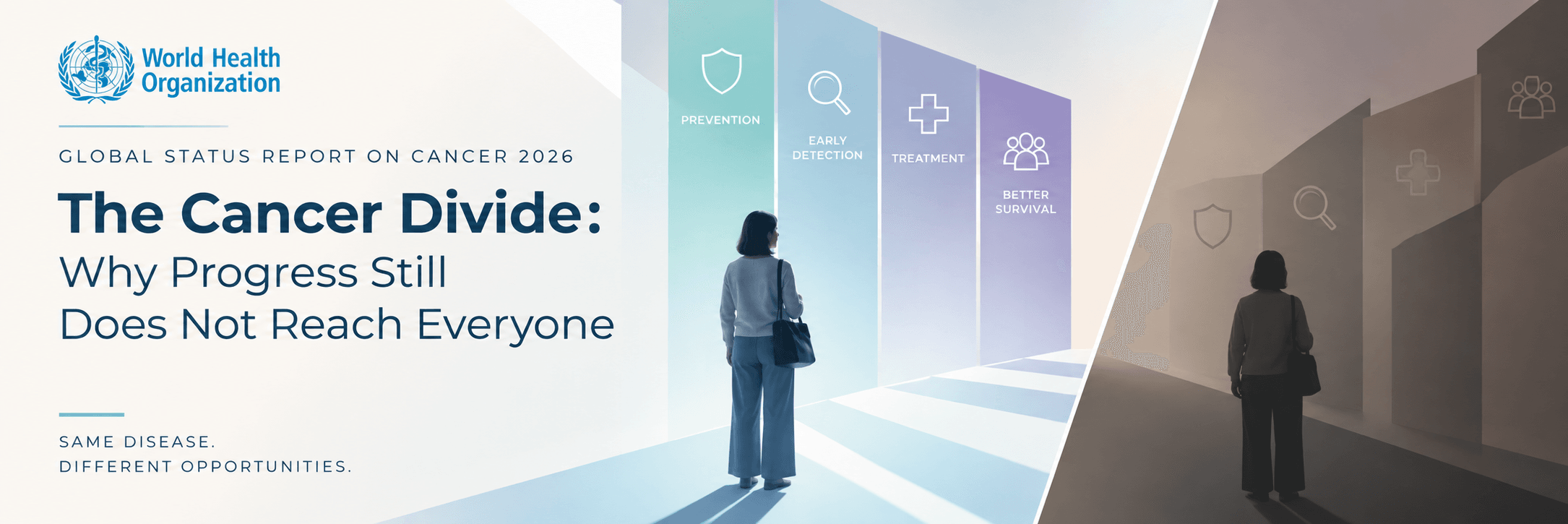
On 8 July 2026, the World Health Organization published its Global Status Report on Cancer 2026, delivering a clear message: cancer remains one of the most significant challenges faced by individuals, societies and health systems. Scientific progress has expanded the possibilities for prevention, earlier diagnosis and more effective treatment. Yet access to these advances remains profoundly unequal.
The central problem is not only the scale of the global cancer burden, but the uneven distribution of progress. Cancer outcomes continue to be shaped by where people live, the resources available to them and the capacity of health systems to translate knowledge into accessible, coordinated and affordable care.
A continuing global challenge
In 2024, 20.6 million people were diagnosed with cancer worldwide and 9.7 million died from it. By 2050, annual diagnoses are projected to reach 35 million and around one in five people will develop cancer during their lifetime.
At the same time, the report provides an important reason for optimism: many cancers can be prevented or treated effectively through already existing interventions. The challenge is ensuring these interventions are implemented consistently, equitably and at scale.
Inequalities between and within countries
One of the report’s most striking findings is the extent of the cancer divide. Five-year survival from breast cancer exceeds 85% in high-income countries but can fall to 42% in many lower-income settings, reflecting systemic inequalities in prevention, early detection, diagnostic capacity, treatment access, workforce availability and financing.
However, the report shows that significant disparities also exist within countries, not only between them. A patient living in a remote area may face longer travel times and limited access to specialised services, while one with fewer resources may struggle to afford private care or time off work. Insurance, health literacy and family support further shape how a patient navigates the system. As a result, two people with the same diagnosis may experience very different pathways, even within one country.
Therefore, the cancer divide stems not only from unequal access to technology and treatment, but also from how care is organized and delivered.
The human and financial burden
Cancer affects far more people than those diagnosed: counting the impact on family and loved ones, WHO estimates that 92% of the global population will be affected by cancer at least once during their lifetime.
The WHO’s global survey on the lived experiences of people affected by cancer revealed its prolonged consequences. Both patients and caregivers reported psychological distress, disruption of employment and family life, social isolation, uncertainty and long-term effects on physical and emotional well-being.
The economic burden is equally significant. Beyond direct medical expenses, cancer often brings lost income, travel expenses and unpaid caregiving. This phenomenon, known as financial toxicity, can occur even when treatment is publicly financed, as families still cover transportation, lost work time or childcare.
Cancer care should be judged not only by survival, but by whether patients can access it without financial and social hardship.
The gap between planning and implementation
Political recognition has increased: 82% of countries now have a dedicated National Cancer Control Plan, compared with around half in 2010. Yet a plan's existence does not guarantee accessible and consistent services.
A plan is effective only when translated into clear responsibilities, realistic budgets and measurable outcomes. It must define how patients enter and move through the system, with delays and outcomes monitored and accountable.
The central challenge is no longer the absence of plans, but the gap between policy intent and what patients experience in practice.
The Greek experience
One of our recent work in Recent work undertaken by CMT Prooptiki on lung cancer care in Greece reflects agrees on several of the issues highlighted in the WHO report.
Despite specialized clinicians, advanced diagnostics and modern treatments, patients may still encounter delayed symptom recognition, fragmented referral routes, diagnostic bottlenecks and uneven geographic access to services. The financial and caregiving burden can also be substantial for those who need to travel, seek private services or rely heavily on family support.
This experience demonstrates that cancer inequality is not determined exclusively by national income or clinical competence. It can also result from fragmented pathways, regional concentration of services, weak coordination and differences in patients’ ability to navigate the system.
From progress to equitable outcomes
The next phase of cancer control depends less on scientific innovation and more on whether health systems can deliver existing knowledge to people early, consistently and without financial harm.
Closing the cancer divide requires stronger capacity, better social and financial protection, integrated care pathways, meaningful patient involvement and sustained implementation.
Medical progress has shown what is possible — the remaining challenge is making it accessible to everyone.